


If you’re looking for an engaging way to teach your students about the delicate balance of nature, the Stomp n’ Chomp game is exactly what you need! Students are naturally fascinated by apex predators and dinosaurs, and this activity taps into that curiosity to explore how the relationship between hunters and their prey shapes entire ecosystems.
What Is the Stomp n’ Chomp Game?
Stomp n’ Chomp is a high-energy classroom simulation designed to model predator-prey dynamics. Unlike many static lessons, this game allows students to see the classic “sine wave” of population growth and decline happen in real-time on their own desks.
I designed this to be a low-prep, high-impact activity. All you need is a 16oz plastic cup (representing the T-Rex), some small items like beads or candy (representing the Triceratops prey), and a 30cm x 30cm taped-off “ecosystem”.
How to Play
To play, students work in small groups to manage their own prehistoric valley. The game is played in rounds, following a simple Dino Math workflow:
- The Hunt: Students drop their T-Rex cup into the ecosystem to “chomp” the prey.
- Predator Survival: Each cup is checked individually. If it caught 0 prey, it starves; 1–2, it survives; and 3+, it reproduces, adding a new “baby” cup to the next round.
- Prey Reproduction: The surviving prey double their population, up to a carrying capacity of 100.
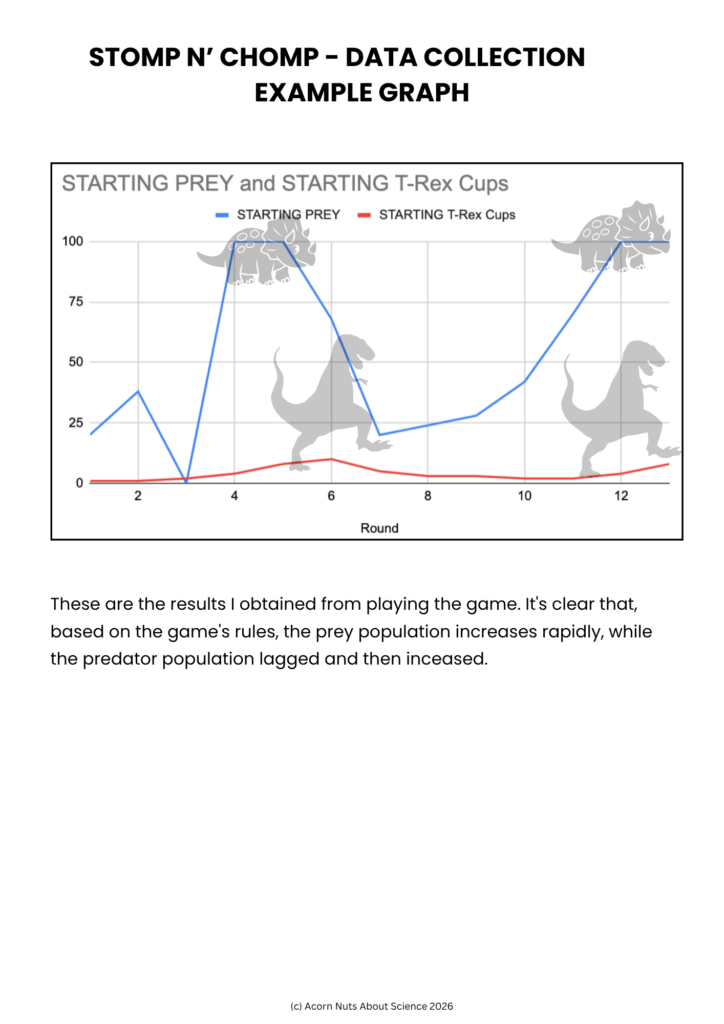
As the rounds progress, students will witness a dramatic “boom and bust” cycle. When prey is plentiful, the T-Rex population explodes—only to crash once they’ve over-hunted their food source.
Why It Works
The beauty of Stomp n’ Chomp is that it makes abstract ecological concepts visible. Instead of just reading about limiting factors or carrying capacity, students are physically removing “starved” predators and adding “newborn” prey.
By the end of the simulation, the connection between resource availability and population size becomes visible. It turns a complex biological theory into a memorable, hands-on experience that sticks with students long after the lab is over.
Data Collection and Reflection
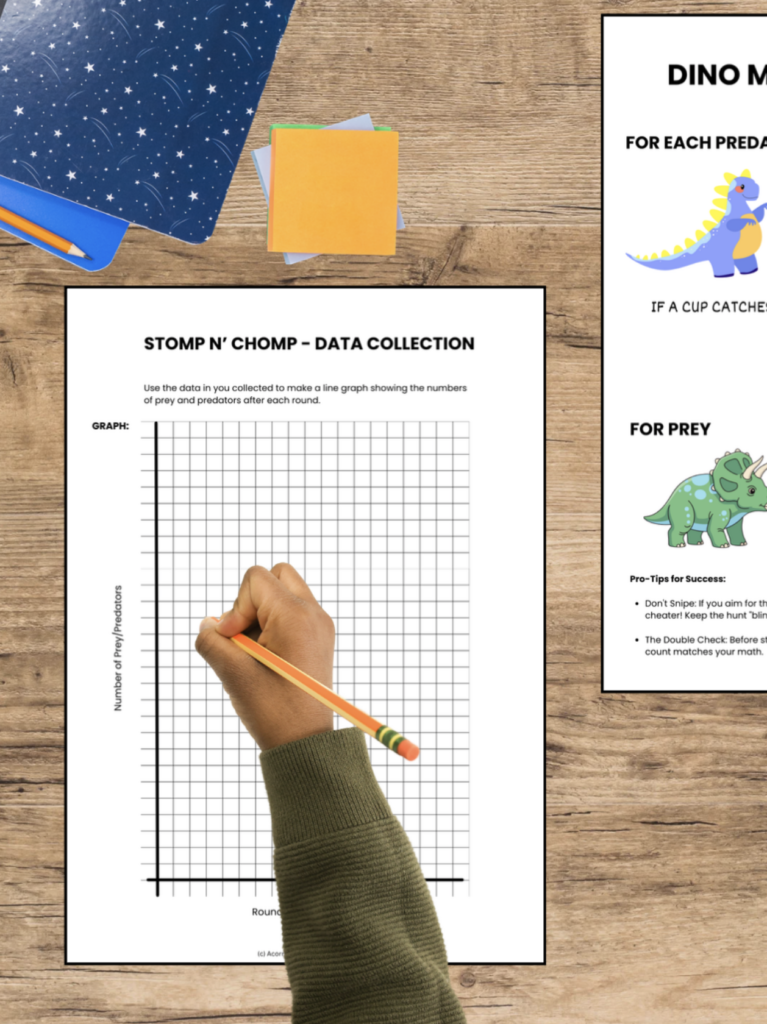
A core part of the resource is the Scoreboard and Data Collection phase. Students track their populations over 8-14 generations and plot the results on a line graph. Seeing the predator line “lag” behind the prey line provides a powerful visual for data interpretation.
The activity also includes a Post-Game Discussion where students reflect on their findings. They’ll analyze what controlled the T-Rex population and even predict how environmental disasters, like a volcano eruption, would disrupt the balance they just observed.
Ready to bring the Stomp n’ Chomp excitement to your classroom?


Comments +
Comments