




Teaching about climate change and global warming isn’t the easiest. It’s not that students don’t care—it’s that global warming often feels like a massive, abstract concept they’ve heard about a thousand times but never truly investigated.
If you want to really get them engaged and learning you have to change their role. Don’t just give them a seat in the classroom; give them a seat at the defense table.
The most effective way to teach NGSS standard MS-ESS3-5 (examining the evidence for global temperature rise) isn’t a lecture. It’s a structured investigation where students must build a “Defense Pack” to prove a specific claim: Human activity is the primary driver of modern global warming.
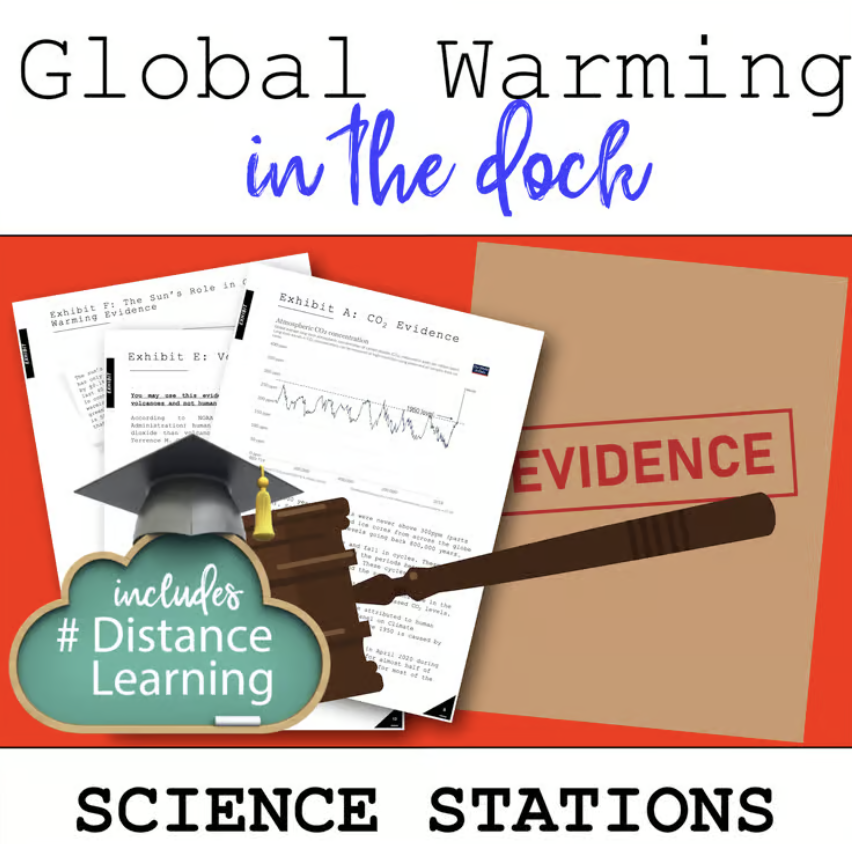
By framing the lesson as a legal case, you transform dry data into “Exhibits” and “Evidence.” Students love it! It’s like letting them bring CSI into the classroom. It’s designed like a criminal case complete with evidence and exhibits.
The Evidence Stations
To make this work, I like to set up six distinct science stations. Each one forces students to look at the data through a different lens:
- The CO2 Baseline: Using ice core data to show that CO2 levels remained below 300ppm for 800,000 years—until the Industrial Revolution.
- The Temperature Trend: Mapping the actual rise in degrees Celsius and identifying “anomalies.”
- Industrial Heavy-Hitters: A deep dive into specific industries. (Did you know if the cement industry were a country, it would be the 3rd largest emitter in the world?)
- Agriculture Infographics: Visualizing the impact of methane and nitrous oxide from global farming.
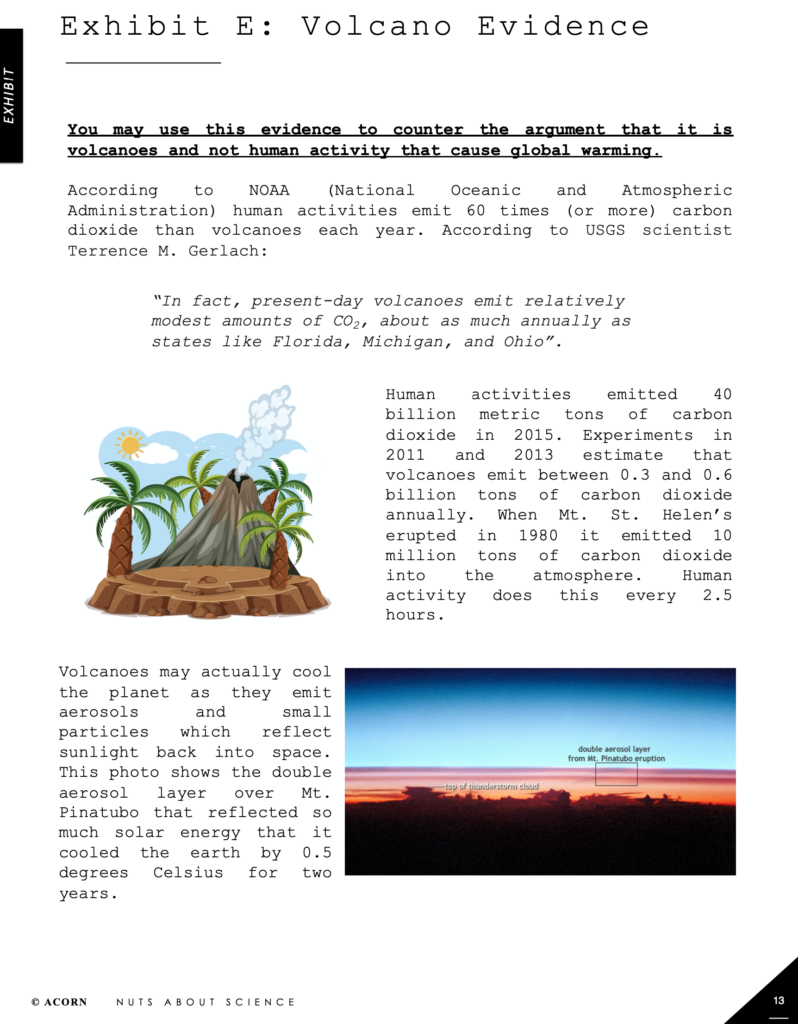
- The Volcano “Alibi”: Countering the common myth that volcanoes emit more CO2 than humans. (Spoiler: Human activity emits 60x more than volcanoes every year.)
- The Sun’s Role: Analyzing satellite data that proves the sun’s energy output hasn’t increased in 40 years, even as our planet warms.
The “hook” of this activity is the conclusion. Instead of a multiple-choice quiz, ask your students to deliver a closing speech to the jury.
They have to decide: which pieces of evidence are the “smoking guns”? How do they handle the “cross-examination” of natural factors like volcanoes or solar cycles? When they have to argue the case themselves, they remember the arguments in a way a textbook never could.
Ready to try it? You can grab the full Global Warming Courtroom Activity here and start building your classroom legal team tomorrow.


Comments +
Comments